Ebook Download Java How to Program, Early Objects (11th Edition) (Deitel: How to Program)
From the description above, it is clear that you require to read this e-book Java How To Program, Early Objects (11th Edition) (Deitel: How To Program) We offer the online book entitled Java How To Program, Early Objects (11th Edition) (Deitel: How To Program) here by clicking the link download. From shared publication by online, you could give much more perks for lots of people. Besides, the visitors will be additionally conveniently to obtain the preferred e-book Java How To Program, Early Objects (11th Edition) (Deitel: How To Program) to read. Find the most preferred and required book Java How To Program, Early Objects (11th Edition) (Deitel: How To Program) to review now and also right here.
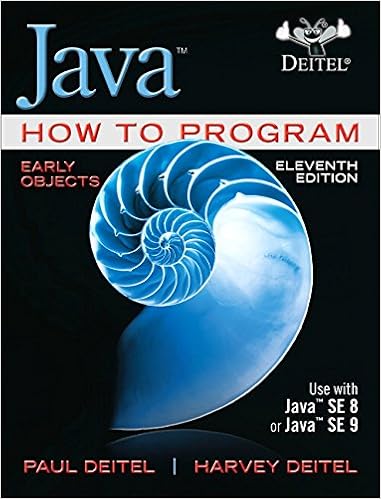
Java How to Program, Early Objects (11th Edition) (Deitel: How to Program)

Ebook Download Java How to Program, Early Objects (11th Edition) (Deitel: How to Program)
Java How To Program, Early Objects (11th Edition) (Deitel: How To Program). The established innovation, nowadays support everything the human demands. It includes the everyday activities, works, office, entertainment, and more. One of them is the fantastic internet link and also computer system. This problem will certainly ease you to assist one of your pastimes, reviewing habit. So, do you have eager to review this e-book Java How To Program, Early Objects (11th Edition) (Deitel: How To Program) now?
The presence of this brand-new publication can be a brand-new resource for you. This publication is truly appropriate for accompanying your lonesome time in the free time. It will be not so delightful when having no activities in your leisure. Watching TV might be bringing. So that means, reviewing Java How To Program, Early Objects (11th Edition) (Deitel: How To Program) could offer you new task as well as bring you brand-new lesson. When you feel so proper with this publication, why do not you take it now?
There is nothing to doubt t get this publication as one of the understanding procedure to boost the understanding as well as impact. When you could admire of the writer as well as the book, you may feel happy to check out the book. As a book, Java How To Program, Early Objects (11th Edition) (Deitel: How To Program) doesn't just come to be the analysis product. It can be the buddy to be always there with you. When you have nothing to do, this publication can be an excellent alternative to make your time better.
read. Why? Again, this is so appropriate with the subject that you truly require currently. It will certainly likewise make your choice of the day to fill up the moment by reading this publication. Also it is a sort of soft file forms, Java How To Program, Early Objects (11th Edition) (Deitel: How To Program) material will not be various with the print out of the book.
For courses in Java programming Unparalleled breadth and depth of object-oriented programming concepts The Deitels’ groundbreaking How to Program series offers unparalleled breadth and depth of programming fundamentals, object-oriented programming concepts and intermediate-level topics for further study. Java How to Program, Early Objects, 11th Edition, presents leading-edge computing technologies using the Deitel signature live-code approach, which demonstrates concepts in hundreds of complete working programs. The 11th Edition presents updated coverage of Java SE 8 and new Java SE 9 capabilities, including JShell, the Java Module System, and other key Java 9 topics. [ Java How to Program, Late Objects, 11th Edition also is available.] Also Available with MyLab Programming. MyLab™ Programmingis an online learning system designed to engage students and improve results. MyLab Programmingconsists of a set of programming exercises correlated to the programming concepts in this book. Through hundreds of practice problems, the system automatically detects errors in the logic and syntax of their code submissions and offers targeted hints that enable students to figure out what went wrong—and why. MyLab Programmingimproves the programming competence of beginning students who often struggle with the basic concepts and paradigms of popular high-level programming languages. For instructors, a comprehensive gradebook tracks correct and incorrect answers and stores the code inputted by students for review. Note: You are purchasing a standalone product; MyLab™ & Mastering™ does not come packaged with this content. Students, if interested in purchasing this title with MyLab & Mastering, ask your instructor for the correct package ISBN and Course ID. Instructors, contact your Pearson representative for more information. If you would like to purchase both the physical text and MyLab & Mastering, search for: 0134800273 / 9780134800271 Java How to Program, Early Objects Plus MyLab Programming with Pearson eText -- Access Card Package, 11/e Package consists of: 0134743350 / 9780134743356 Java How to Program, Early Objects 0134752120 / 9780134752129 MyLab Programming with Pearson eText -- Access Code Card -- for Java How to Program, Early Objects Students can use the URL and phone number below to help answer their questions: http://247pearsoned.custhelp.com/app/home 800-677-6337
Your recently viewed items and featured recommendations
›
View or edit your browsing history
After viewing product detail pages, look here to find an easy way to navigate back to pages you are interested in.
Product details
Series: Deitel: How to Program
Paperback: 1296 pages
Publisher: Pearson; 11 edition (March 2, 2017)
Language: English
ISBN-10: 9780134743356
ISBN-13: 978-0134743356
ASIN: 0134743350
Product Dimensions:
7 x 1.8 x 9 inches
Shipping Weight: 3.7 pounds (View shipping rates and policies)
Average Customer Review:
3.6 out of 5 stars
16 customer reviews
Amazon Best Sellers Rank:
#292,109 in Books (See Top 100 in Books)
I had previously given this book a one-star review as I felt the frustrations I encountered in my Java education were rooted in the issues I had with this book. I still feel this is true, but now more time has passed where I had reviewed competitive products and even progressed further through this book.I know I learn best by going through exercises, and not at all by reading. I think math textbooks are the best example of my meaning. I don't feel that the Java book market really provides the kind of book that would be best for me, so I have to admit that from all my searching that this book seems to come closest. For this reason, I am willing to adjust my rating up one star.This book is over one thousand pages. It provides a wide range of content, and I do appreciate that the authors tried to cover so much of Java in a single book. I think though that some of these chapters need to have their design modified. Chapter 12 and 13 which introduce a new programmer to JavaFX through what seems to be an assumption that the programmer is familiar with XML. As a new programmer, I think it is far easier to learn JavaFX without leaving the Java language or learning how to use and incorporate Scene Builder. I think it is a mistake to expect this. Also, the Chapter 12 tutorial which the book uses to introduce JavaFX seems to end abruptly before it finishes. For myself, beyond the exercises at the end of the chapter, I couldn't use these chapters at all. I ended up learning JavaFX from Bucky's newboston channel on YouTube.I have four or five other Deitel books, and all of them are filled with mistakes. There are occasional exercise instructions that seem like they have been haphazardly edited as they contradict themselves from one sentence to the next. There are frequent exercises which have little to do with the current chapter subject material and actually are designed for subjects not yet covered. There are political exercises at the end of every chapter to teach you about global warming or some such thing. Half the time there is no programming lesson involved in these.This book takes on a wide range of material, and you can learn Java from this book. Only because I think this book can work despite its shortcomings am I willing to bump it up another star to three stars. This is the book that taught me Java. Most people seem to love it, but I think in a better book market this would be a one-star product.
You'd think that Amazon would have a better method to find alternative book versions.If you are taking a course that requires this book and will be needing the programming lab - do NOT get this book.It only includes the code for the companion website, not the programming one.The one with the programming lab is this one: https://www.amazon.com/Program-Objects-Programming-Pearson-Package/dp/0134800273/Otherwise - it's a programming book - so it's fairly good, not perfect - but certainly better than most.
This would be a good book for someone that has just started programming or maybe has some simple understanding of coding. If you write c++ or know OO methodology or even just are proficient in c then 60-70% of the words in this book are a waste of your time as they explain basic programming constructs, data structures, and simple algorithms like traversing a multi dimensional array... it does cover the Java language well as an introduction. And it would be a great book for someone new to software coding where java may be their first language to seriously study. It does contain a lot of good nuggets of real world wisdom set in little stand out blocks. Even experienced programmers may find a nugget or two in them. But if you already know tree traversing and maps and basic OO methods, you might look for a different java book. One that focuses on the language rather than on coding.
I have the gotten up to chapter 8. I found most of the exercises from chapter 2-6 to be very easy to grasp from the content of the text. However, chapter 7 ramps up the difficult once you hit the knight touring problem. I had to search online how to solve the knight touring problem. Maybe I did not read the problem correctly, but I found it to be quite difficult. I did not even attempt the queen movement problem.One criticism I find with the book is sometimes the instructions can be vague. I guess they are created that way to sort of replicate real life scenarios.Chapter 8's problems so far are not too bad, but I have only completed one exercise (8.5). I initially found this problem confusing because I did not see the purpose of the whole "seconds from midnight" variable. The exercise itself does not really explain what you are supposed to do with that variable.I find Deitel's text to be better than the Daniel Liang text, which I believe is written for those already familiar with the subject matter. I already have bought their visual c# text, and will begin looking into that text once I finish up on the java text.
This textbook is the easiest to understand Java programming textbook I've ever encountered. I contribute it to me finally understanding Java.
I had borrowed this book for a beginner’s java programming course and ended up buying it afterwards. It was written in great detail and had very specific practice/example code that allows for easy understanding throughout the book.
My Object Oriented Programming professor said we needed this book. I didn't open it once.
I am happy with the book. However, it was severely damaged once I got it. I have taken pictures of evidence just in case I am possibly charged for damage even though I received it that way.
Java How to Program, Early Objects (11th Edition) (Deitel: How to Program) PDF
Java How to Program, Early Objects (11th Edition) (Deitel: How to Program) EPub
Java How to Program, Early Objects (11th Edition) (Deitel: How to Program) Doc
Java How to Program, Early Objects (11th Edition) (Deitel: How to Program) iBooks
Java How to Program, Early Objects (11th Edition) (Deitel: How to Program) rtf
Java How to Program, Early Objects (11th Edition) (Deitel: How to Program) Mobipocket
Java How to Program, Early Objects (11th Edition) (Deitel: How to Program) Kindle